A Catholic funeral usually has three parts: a vigil (often at the funeral home the evening before), a funeral Mass at the parish church, and a short committal service at the cemetery. The Church’s ritual book, the Order of Christian Funerals, provides prayers for each, plus shorter prayers for the hours right after death and for moving the body to the church.
To plan one, call the parish first, then the funeral home and cemetery. The parish will help you pick readings and music, schedule the Mass, and explain local guidelines on things like eulogies. Families often worry about doing it “right.” In practice, the Church has already done most of the work, and the planning is mostly a matter of making a few choices well.
The three main rites at a glance
| Rite | Where | What happens | Who usually leads |
|---|---|---|---|
| Vigil for the Deceased (wake) | Funeral home, home or church | Scripture readings, a brief homily or reflection, intercessions and prayers | Priest, deacon or trained lay minister |
| Funeral Liturgy (usually a Mass) | Parish church | Reception of the body, Liturgy of the Word, Eucharist, Final Commendation and Farewell | Priest (a deacon or lay minister may lead a funeral liturgy outside Mass) |
| Rite of Committal | Graveside, mausoleum or columbarium | Brief prayers of farewell as the body or ashes are laid to rest | Priest, deacon or lay minister |
The Diocese of Toledo’s guide adds that, depending on family preference or pastoral need, any single rite may be used as the only funeral rite. The full sequence is the norm, but there’s flexibility.
Step one: call the parish
When someone dies, the funeral home often needs to be called right away. But for planning the funeral itself, the Diocese of Toledo, for example, advises that your first call be to the parish. Canon law says a Catholic’s funeral is generally celebrated in his or her own parish church, though the family can choose another church with that church’s consent after notifying the proper pastor (canon 1177).
Have a few things ready when you call:
- The full name of the person who died and the parish they belonged to, if any.
- Preferred dates and times, and the funeral home you’re working with.
- Whether the body will be present, or whether cremation has taken place or is planned.
- Names of family members who might read or serve at the Mass.
Be aware that some days are off-limits. The General Instruction of the Roman Missal says a funeral Mass may be celebrated on any day except solemnities that are holy days of obligation, Holy Thursday, the Easter Triduum, and the Sundays of Advent, Lent and Easter (GIRM 380). On those days the parish can suggest alternatives.
The vigil: where stories belong
The vigil is the Church’s prayer at the wake. It’s a short liturgy of Scripture readings, a brief homily or reflection, intercessions and prayers, and it can be led by a priest, deacon or lay minister. The Archdiocese of Detroit calls it “the official prayer of the Church” for this moment and says it “should never be omitted.”
It’s also the most natural place for personal memories. The Order of Christian Funerals allows a family member or friend to speak in remembrance at the vigil (OCF 80), and Detroit’s guidance notes that non-biblical readings, poems and favorite non-liturgical music can be included there. If your family wants several people to share stories, plan them for the vigil.
Many families also want to pray the Rosary. It’s a beautiful devotion, but it isn’t part of the vigil and doesn’t replace it. Detroit suggests praying it at another time during the visitation.
The funeral Mass: what to choose
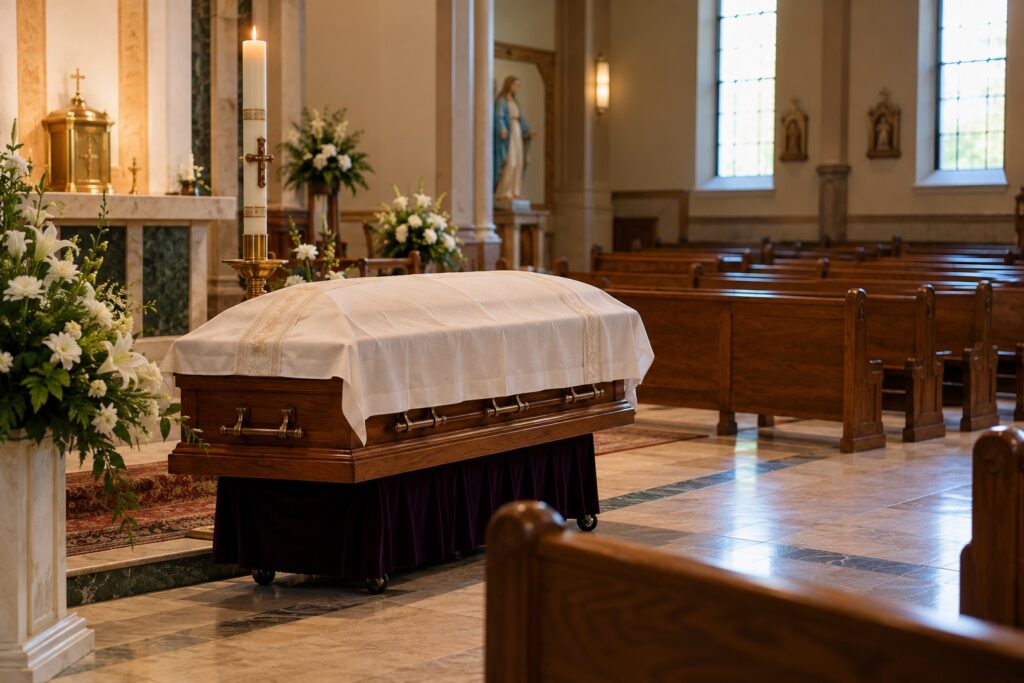
The funeral Mass is the heart of a Catholic funeral. The Catechism calls the Eucharist “the heart of the Paschal reality of Christian death” (CCC 1689). The Mass begins with signs of baptism: the casket is sprinkled with holy water, covered with a white pall that recalls the baptismal garment, and placed near the Easter candle.
Readings
The family usually chooses from a list of approved Scripture passages: typically a first reading, a responsorial psalm, often a second reading, and the Gospel. Your parish will give you the options. Choose passages that fit the person and that will speak to those who are grieving. The Catechism notes that funeral readings need “very careful preparation” because the congregation may include people who rarely attend church and friends who aren’t Christians (CCC 1688). Ask readers who can proclaim clearly, and give them the text ahead of time.
Music
Music at the funeral Mass is liturgical music, and the parish music director or cantor can help you choose hymns and settings. If there’s a secular song that meant a great deal to the person, the vigil is a better place for it. Detroit’s guidance notes that favorite non-liturgical music may be played there.
The homily and words of remembrance
The homily at a funeral Mass is about Christ’s death and resurrection and God’s mercy, seen in the life of the person who died. The General Instruction says there should be “a short homily, but never a eulogy of any kind” (GIRM 382).
The ritual does allow a member or friend of the family to “speak in remembrance of the deceased before the final commendation begins” (OCF 170), but dioceses set their own guidelines. The Diocese of Erie, for example, limits it to one speaker at Mass, asks that remarks be about three to five minutes, mention the person’s faith life, and be shown to the priest in advance. Ask your parish what applies where you live.
Other ways to take part
Toledo’s guide notes that family members and friends can take on ministerial roles, such as reading, if they are properly prepared. Ask the parish which roles are available and who will help the readers prepare. Friends who can’t be there often ask for a Mass to be offered for the person instead, and our guide to Mass cards and Mass intentions explains how that works.
The committal and the cemetery
The Rite of Committal is brief: the final farewell at the grave, tomb, mausoleum or columbarium. Toledo’s guide notes it can be expanded if it’s the only rite being celebrated.
You’re free to choose where to be buried unless the law prohibits it (canon 1180), and many Catholics choose a Catholic cemetery because it’s set aside for Christian burial and prayer. Diocesan cemetery offices can help you choose between in-ground burial, mausoleum entombment or placement of cremated remains, and explain fees and notice requirements. If cremation is part of your plans, the Church asks that the remains be buried or entombed, not scattered or kept at home. Our article on what the Church teaches about cremation covers the details.
Working with the funeral home
A good funeral director coordinates the three rites with the parish and cemetery, handles legal paperwork and obituary notices, and arranges transportation. Tell the director early that you want a Catholic funeral Mass so the timing works for the parish.
It helps to work with a funeral home that understands Catholic practice. You can search our directory for Catholic-owned and Catholic-friendly funeral homes, or browse states with many listings, such as Texas, Ohio and Florida.
Frequently asked questions
Can a non-Catholic spouse or relative have a Catholic funeral?
Sometimes. Canon law allows catechumens to receive Catholic funerals, and the local bishop may permit them for baptized members of other Christian communities when their own minister isn’t available and it wouldn’t go against their wishes (canon 1183). Talk with the parish.
How soon after death is the funeral?
It depends on the parish calendar, the cemetery and the family’s needs. Call the parish early so the date can be set before notices go out.
Does a Catholic funeral have to include a Mass?
No. A funeral Mass is the norm, but the Church also has a funeral liturgy outside Mass for special circumstances, such as when a priest isn’t available or a funeral Mass isn’t permitted that day. A deacon or lay minister may lead it.
Sources and further reading
- Catechism of the Catholic Church, nos. 1684 to 1690 (Christian funerals)
- General Instruction of the Roman Missal, nos. 379 to 385
- Diocese of Toledo: Funeral Rites and Liturgical Moments
- Archdiocese of Detroit: What are the funeral rites?
- Diocese of Erie: Policy on Words of Remembrance at Funerals
Today is All Souls Day, a good day to write down a few wishes for your own funeral (readings, music, where you’d like to be buried) and tell someone where to find them.