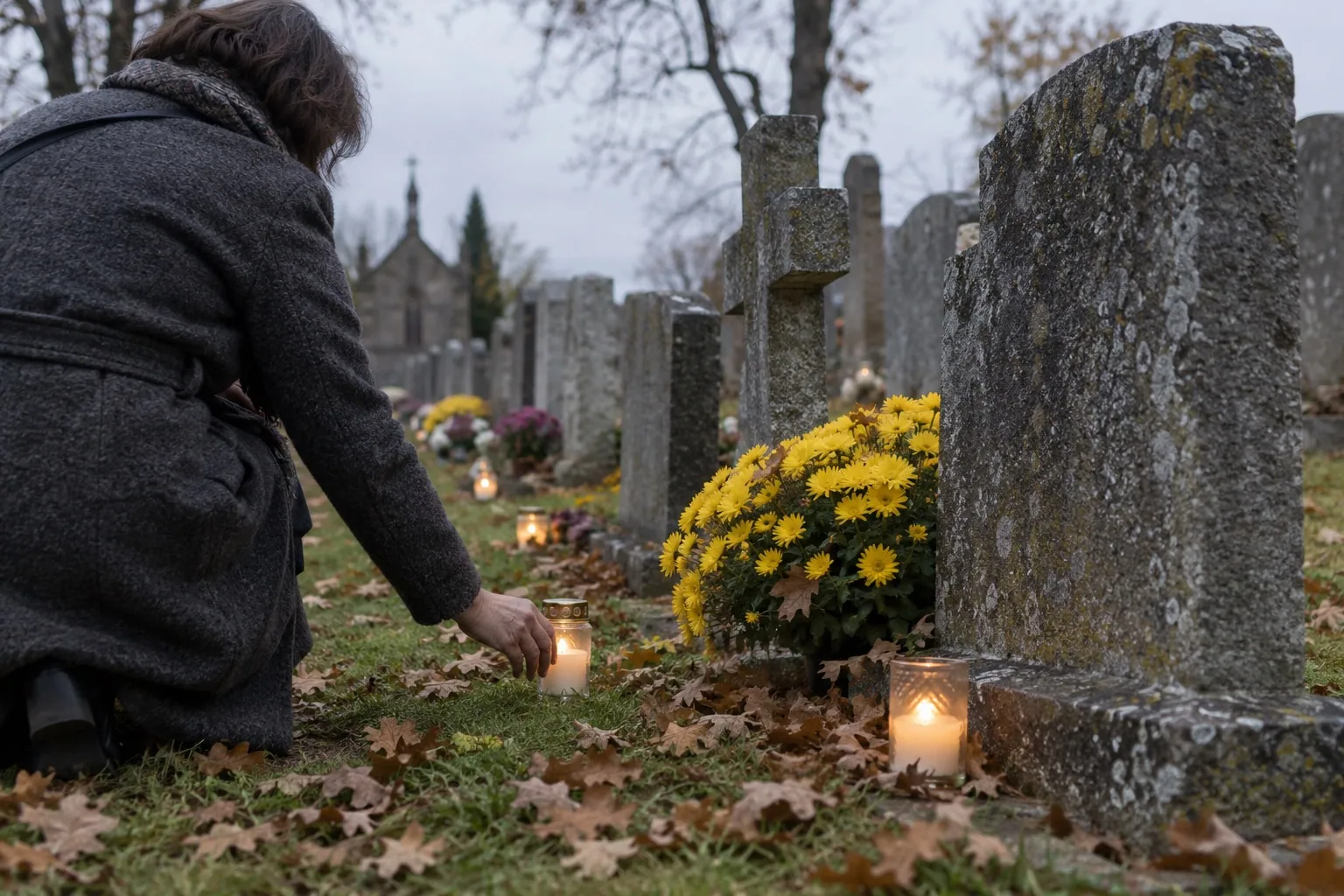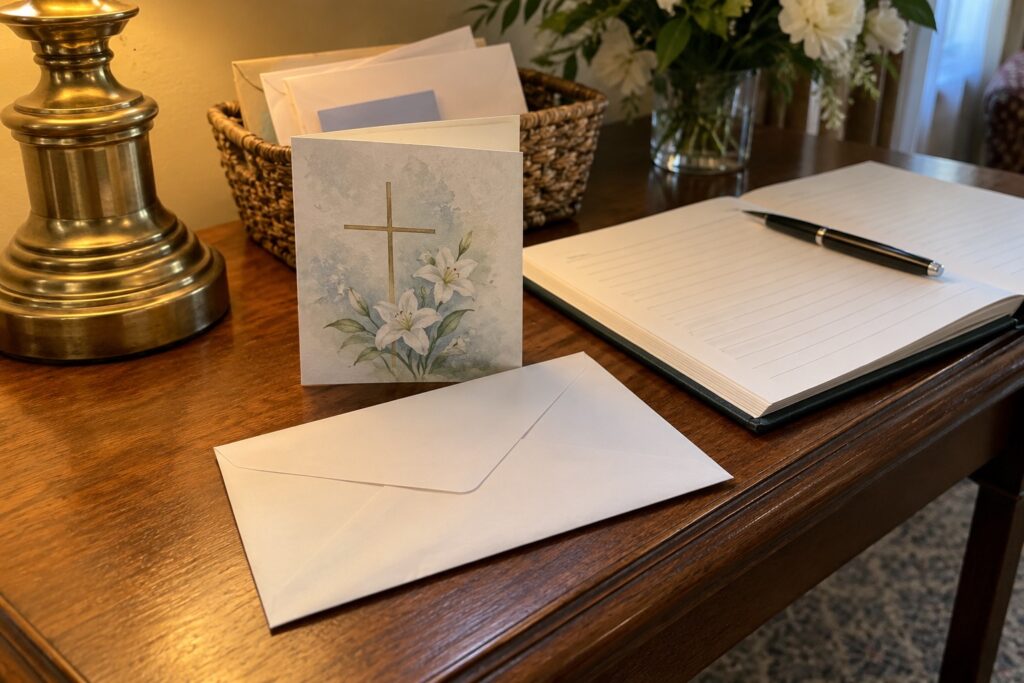
A Mass card tells someone that a Mass will be offered for a particular person. Most people meet them at a wake, tucked among the sympathy cards: “The Holy Sacrifice of the Mass will be offered for the repose of the soul of…” To get one, you contact a parish (or a religious community), ask to have a Mass offered for the person, usually make an offering, and receive a signed card to give to the family.
That’s the whole process. The meaning behind it is deeper than the card, though, and knowing a little about Mass intentions helps you do it well, whether the person has died or is very much alive.
What a Mass intention is
Every Mass is offered for the whole Church and the whole world. A Mass intention adds a particular person or need, and the priest offers that Mass for it. Canon law puts it simply: “A priest is free to apply the Mass for anyone, living or dead” (canon 901).
Catholics have asked for Masses for the dead since the early centuries. The Catechism says the Church has offered prayers for the dead from the beginning, “above all the Eucharistic sacrifice, so that, thus purified, they may attain the beatific vision of God” (CCC 1032). It also explains that the Eucharist is offered “for the faithful departed who ‘have died in Christ but are not yet wholly purified'” (CCC 1371). Having a Mass said for someone who has died is one of the most meaningful things a Catholic can do for them, and November, which opens with All Saints and All Souls Day, is a natural time to arrange one.
Masses for the living are just as normal. People request them for a birthday or anniversary, a sick friend, a new baby, a marriage in trouble, or someone far from the faith.
How to have a Mass said for someone
- Call or visit the parish office. Most parishes keep a Mass intention book or calendar. Some take requests online or have envelopes in the vestibule.
- Give the person’s name and say whether the Mass is for someone living or for the repose of the soul of someone who has died.
- Choose a date if it matters (an anniversary of death, a birthday) or ask for the next open date. Ask how far ahead the calendar is booked.
- Make the customary offering, if you’re able. The parish staff can tell you what it is.
- Ask for a Mass card if you want to give one. You’ll sign it, and the parish will sign or stamp it as well.
If a parish has more requests than it can schedule, canon law allows the Masses to be celebrated elsewhere unless you say otherwise (canon 954). Under the 2025 Vatican rules, bishops can also send surplus intentions to parishes or mission territories in need. If the date and place matter to you, mention that when you ask.
About the Mass offering (stipend)
The offering is often called a stipend. It isn’t a fee, and a Mass can’t be bought. Canon law requires that any appearance of trafficking or trading be kept entirely out of Mass offerings (canon 947). The person who gives an offering “contribute[s] to the good of the Church” and shares in its concern to support its ministers and works (canon 946).
Here’s how the amount works. The customary offering is set for a whole church province by its bishops, and where there’s no such decree, diocesan custom applies (canon 952). A priest isn’t allowed to ask for more than that amount, though he may accept a larger or smaller offering freely given. The law also earnestly recommends that priests celebrate Mass for people’s intentions “especially the needy, even if they have not received an offering” (canon 945). If money is tight, say so. No parish should turn away a request because someone can’t pay.
Each offering is tied to its own Mass. When separate people give separate offerings, separate Masses are to be applied for them (canon 948). A priest may not accept more Mass offerings than he can fulfill within a year (canon 953).
In April 2025 the Vatican’s Dicastery for the Clergy updated the rules for “collective intentions,” where several offerings are combined for one Mass. According to Catholic News Agency’s report, such Masses are allowed only when every donor has been told and has explicitly agreed, and that consent “can never be presumed.” The decree also called replacing a promised Mass with a simple mention during the liturgy “gravely illicit.” If you want your intention to have its own Mass, which is the normal practice, you don’t need to do anything special.
Mass cards, enrollment cards and Gregorian Masses
Mass cards
A Mass card means one specific Mass will be offered for the person. Sympathy Mass cards are for the deceased. Many parishes also have cards for the living, for birthdays, illness or other occasions.
Enrollment cards
Enrollment cards look similar but work differently. A religious order or mission typically enrolls the person, living or deceased, in a share of the community’s ongoing Masses and prayers rather than scheduling one Mass. These are a good gift too. Read the card or ask the community exactly what the enrollment includes.
Gregorian Masses
Gregorian Masses are a series of thirty Masses offered on thirty consecutive days for one person who has died. The custom takes its name from Pope St. Gregory the Great, who wrote in his Dialogues that he had Mass offered for a deceased monk named Justus for thirty days, “so that no one day pass” without it. Because the series has to be unbroken, a parish may not be able to take the request, so ask your parish or a religious community whether they can.
Mass card etiquette for wakes and funerals
- Give the card at the wake or funeral home visitation, or mail it to the family. At a visitation, look for the card basket or table, or hand it to a family member.
- You can give a Mass card to any grieving family. A Mass may be offered for anyone, including someone who wasn’t Catholic.
- Write a short personal note inside. A line about something you remember is often what the family keeps.
- Don’t mention the offering amount. The card is about the Mass.
- If you’d like to attend the Mass, ask the parish for the date and time and tell the family. Families often appreciate knowing when and where it will be.
If you’re not Catholic and want to give a Mass card to a Catholic friend’s family, you can. Call any Catholic parish and say you’d like a Mass offered for the person who died. Our guide to being a Catholic is a friendly starting point if you’d like to know more about the faith behind the custom.
Frequently asked questions
Can I have a Mass said for a living person?
Yes. Masses are often offered for the living, for health, birthdays, anniversaries, conversion or any special need.
Will the person’s name be read at Mass?
Often, yes. Many parishes list the intention in the bulletin or mention it during the Mass, but practices vary. Ask the parish if it matters to you.
Can the family attend the Mass?
Yes. If the date and parish are known, tell the family. Some families make a point of attending each Mass offered for their loved one.
How soon will the Mass be said?
It depends on how busy the parish calendar is. A priest may not take on more Mass offerings than he can fulfill within a year, and busy parishes sometimes send intentions to other priests.
Sources and further reading
- Code of Canon Law, canons 945 to 958 (the offering given for Mass)
- Catechism of the Catholic Church, nos. 1030 to 1032
- Catechism of the Catholic Church, no. 1371
- Catholic News Agency: Vatican updates rules for Mass intentions (2025), via Catholic World Report
- St. Gregory the Great, Dialogues, Book 4 (1911 translation, archived copy)
Planning a funeral now? You can search our directory for Catholic-owned funeral homes, or browse listings by state.