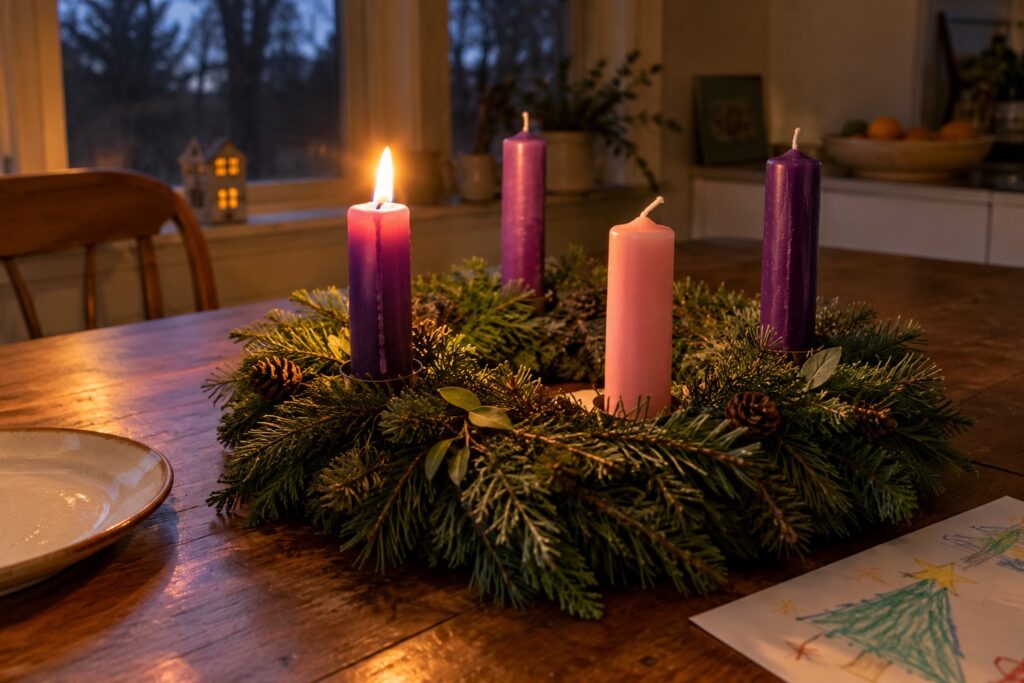
Advent 2026 begins on Sunday, November 29, and in many Catholic homes the first sign of it is a ring of evergreen branches with four candles on the kitchen table. The Advent wreath is simple: one candle lit the first week, two the second, and so on until all four are burning just before Christmas.
The meaning, in the Church’s own words, is about light growing in darkness. The Vatican’s Directory on Popular Piety and the Liturgy calls the wreath, “with the progressive lighting of its four candles, Sunday after Sunday,” a “recollection of the various stages of salvation history prior to Christ’s coming and a symbol of the prophetic light gradually illuminating the long night prior to the rising of the Sun of justice” (no. 98).
What the Advent wreath means
The Church treats the wreath as a devotion, not part of the liturgy itself, and keeps its official explanation short. The light is the heart of it. Each week a little more light pushes back the dark, just as the prophets’ promises grew clearer through the centuries before Christ was born. The Directory’s phrase “Sun of justice” comes from the prophet Malachi (Mal 3:20), and it also points to Zechariah’s canticle in the Gospel of Luke (Lk 1:78).
The Church’s books don’t assign official meanings to the circle or the greenery. Still, it’s hard to miss the fit: a ring has no end, and branches that stay green through winter speak of life that doesn’t die. Those are reasonable reflections for a family to talk about, as long as they’re presented as reflections and not as rules.
Why three violet candles and one rose
The rules for the wreath are in chapter 47 of the Book of Blessings, the Church’s official collection of blessings in its U.S. edition. As reproduced by the Archdiocese of Newark’s Worship Office, it says the wreath is “customarily” a “circle of ever-green branches into which are inserted four candles. According to tradition, three of the candles are violet and the fourth is rose. However, four violet or white candles may also be used” (no. 1510).
The colors follow the liturgical colors the priest wears. Violet is the color of Advent, a season of preparation and hopeful waiting. Rose belongs to the Third Sunday of Advent, called Gaudete Sunday from the first word of that day’s entrance antiphon, Gaudete, “Rejoice.” The Book of Blessings says simply: “The rose candle is lighted on the Third Sunday of Advent, also known as Gaudete Sunday” (no. 1511).
Customs vary elsewhere. A liturgy note from the Diocese of Prince George in Canada points out that “the colour of the candles is not the main issue” and that in some European countries the custom is four red candles. For the wider world of Catholic signs and images, our guide to 22 Catholic symbols and their meaning is a good companion.
The popular candle names
You may see each candle given a name, such as the Prophecy Candle, the Bethlehem Candle, the Shepherd Candle (the rose one) and the Angel Candle, or hope, preparation, joy and peace. Inside the Vatican lists both sets. These names are pious custom, not Church law, and they vary from place to place, so don’t worry if your parish uses different ones.
How to light the wreath, week by week in 2026
The Book of Blessings says the blessing of the wreath “takes place on the First Sunday of Advent or on the evening before” (no. 1509), and that “the number of candles lighted each week corresponds to the number of the current week of Advent” (no. 1511).
| Week | Sunday | Candles lit |
|---|---|---|
| First Sunday of Advent | November 29, 2026 (or the evening of Saturday, November 28) | One violet; bless the wreath |
| Second Sunday of Advent | December 6, 2026 | Two violet |
| Third Sunday of Advent (Gaudete) | December 13, 2026 | Two violet and the rose |
| Fourth Sunday of Advent | December 20, 2026 | All four |
This year the fourth week is short. Christmas Eve falls on Thursday, December 24, so the last candle burns for only a few days before Christmas.
For the prayer itself, the Book of Blessings suggests that at home “the opening prayer of the Sunday Mass is recited when the candles are lighted,” possibly with an Advent hymn and a Scripture reading, and adds that the lighting “may fittingly be included as a part of the evening meal” (no. 1515). A Sunday missal or your parish’s worship aid will have the opening prayer for each week.
A family blessing for the Advent wreath
The Book of Blessings says that at home “it is appropriate that it be blessed by a parent or another member of the family” (no. 1514). One of the blessing prayers in the book (no. 1520), as reproduced by the Diocese of Prince George, reads:
Lord our God,
we praise you for your Son, Jesus Christ:
he is Emmanuel, the hope of the peoples,
he is the wisdom that teaches and guides us,
he is the Savior of every nation.
Lord God,
let your blessing come upon us
as we light the candles of this wreath.
May the wreath and its light
be a sign of Christ’s promise to bring us salvation.
May he come quickly and not delay.
We ask this through Christ our Lord.
R. Amen.
A simple order for the first night:
- Gather everyone at the table with the lights dimmed.
- Begin with the Sign of the Cross.
- Read a short Scripture passage, such as the Gospel of the First Sunday of Advent.
- A parent prays the blessing above.
- Light the first violet candle.
- Sing or say an Advent hymn. “O Come, O Come, Emmanuel” is the familiar choice.
- Eat dinner by the light of the wreath.
On later Sundays, skip the blessing and use the Sunday’s opening prayer, lighting one more candle each week. Some families also light the wreath at dinner on weeknights.
Where the Advent wreath came from
The wreath is younger than many people assume. Inside the Vatican reports that “the first Advent wreath dates to 1839 and was the idea of Johann Hinrich Wichern,” a Protestant pastor in Hamburg. From there it spread through Germany and beyond. By 2001 the Directory on Popular Piety could describe four candles on green fronds as “a symbol of Advent in many Christian home[s], especially in the Germanic countries and in North America.”
That shared history is part of its appeal. As the Diocese of Prince George’s liturgy note puts it, the wreath is “one thing that most Christian denominations can share and appreciate in Advent.”
Frequently asked questions
Do I have to use violet and rose candles?
No. The Book of Blessings calls three violet and one rose the traditional choice but permits four violet or four white candles.
Can a layperson bless an Advent wreath?
Yes. At home the Book of Blessings says a parent or another family member may bless it, and it adds that the wreath “may be blessed by a priest, deacon, or a lay minister” (no. 1516, as quoted by the Archdiocese of Newark).
What about a fifth white candle?
Some families and parishes add a white “Christmas candle” in the center, lit on Christmas. It’s a popular addition, not part of the Book of Blessings.
Where can I find an Advent wreath or candles?
Catholic gift shops often carry wreath frames and candle sets, and Small Business Saturday on November 28 falls the day before Advent begins. You can look for Catholic-owned shops near you in our directory.