Catholics pray to saints for the same reason they ask friends and family to pray for them: they believe the saints are alive in Christ, that they care about us, and that their prayers help. When a Catholic says “St. Joseph, pray for us,” he isn’t worshiping Joseph or treating him as a substitute for God. He’s asking a friend of God to pray alongside him.
The Catechism says it directly. The saints in heaven “do not cease to intercede with the Father for us,” and they do it through “the one mediator between God and men, Christ Jesus” (CCC 956). “We can and should ask them to intercede for us and for the whole world” (CCC 2683).
Part of the confusion is the word “pray” itself. In older English it often simply meant “ask,” as in “pray tell.” When Catholics pray to a saint, they are asking. They worship God alone.
Worship belongs to God alone
Catholic theology draws a sharp line between worshiping God and honoring the saints. The traditional terms come from Greek. Latria is the worship given to God alone. Dulia is the honor given to the saints, and hyperdulia is the higher honor given to the Virgin Mary. The Catholic Encyclopedia notes that theologians insist the difference “is one of kind and not merely of degree,” as far apart “as are the creature and the Creator.” St. Augustine already made the distinction in The City of God in the fifth century.
The Catechism applies the same principle to statues and images. The honor paid to them is “a ‘respectful veneration,’ not the adoration due to God alone,” and “whoever venerates an image venerates the person portrayed in it” (CCC 2132). Even devotion to Mary, the Catechism says, “differs essentially from the adoration which is given to the incarnate Word and equally to the Father and the Holy Spirit” (CCC 971).
| Worship (latria) | Honor and intercession (dulia) | |
|---|---|---|
| Given to | God alone | The saints (Mary receives a higher honor, hyperdulia) |
| What it means | Adoration, sacrifice, total self-giving | Love, respect, imitation, asking for prayers |
| Example | The Mass, adoration of the Eucharist | “St. Monica, pray for my son” |
| Source of grace | God himself | God, through Christ; the saint only asks |
Why ask the saints at all? The communion of saints
The deeper reason Catholics pray to saints is a line from the Apostles’ Creed: “I believe in… the communion of saints.” Catholics believe death doesn’t cut the bond between members of Christ’s body. The Catechism describes the Church as existing in three states at once: disciples still on earth, those who have died and are being purified, and those already in glory. All of them “form one Church and in Christ cleave together” (CCC 954). The Church celebrates that bond every November on All Saints Day and All Souls Day.
If Christians on earth can pray for one another, and Scripture tells them to, it would be strange if that stopped when someone reached heaven, closer to God than ever. St. Jerome made that argument in his reply to a critic named Vigilantius: if the apostles and martyrs could pray for others while still in the body, “how much more after their crowns, victories, and triumphs are won.”
The saints also give us examples. The Church canonizes people, the Catechism says, to propose them “as models and intercessors” (CCC 828). Asking for a saint’s prayers usually goes hand in hand with learning from the way that saint lived.
What about “one mediator”?
The most common objection quotes 1 Timothy 2:5, which says there is one mediator between God and humanity, Christ Jesus. Catholics agree completely. The Catechism quotes that very verse when it explains how the saints intercede (CCC 956), and it calls Jesus “the one intercessor with the Father on behalf of all men” (CCC 2634).
The question is whether asking others to pray for us competes with Christ’s role. Catholics answer no, for the same reason a Protestant asking her church’s prayer chain to pray for her mother doesn’t compete with Christ. Christian intercession, the Catechism explains, “participates in Christ’s, as an expression of the communion of saints” (CCC 2635). St. Thomas Aquinas put it simply: we pray to God alone as the one who grants what we ask, and to the saints “that by their prayers and merits our prayers may be efficacious.”
The Catechism makes the same point about Mary: her role “in no way obscures or diminishes this unique mediation of Christ, but rather shows its power” (CCC 970).
What Scripture says
Catholics usually point to several passages:
- James 5:16 says the prayer of a righteous person is powerful. The saints in heaven are the righteous made perfect.
- Hebrews 12:1 describes believers as surrounded by “so great a cloud of witnesses,” right after a long list of faithful men and women who had died.
- Revelation 5:8 and 8:3 to 4 show the prayers of God’s holy ones rising before God’s throne like incense.
- Jesus says God “is not God of the dead, but of the living,” because all are alive to him (Luke 20:38; see also Mark 12:27).
- In Luke 16, the rich man in the afterlife pleads on behalf of his brothers still on earth, a story that assumes the dead are aware and concerned.
None of these verses spells out the full practice, and many Christians read them differently. For Catholics they fit together with the Church’s long tradition, voiced by Fathers like St. Jerome and taught by the Council of Trent in 1563: “It is good and useful suppliantly to invoke them.”
Common misunderstandings
- “Catholics think saints answer prayers by their own power.” No. Every grace comes from God through Christ. The saints ask; God gives.
- “Catholics must pray to saints.” Catholics are encouraged to, but the heart of Catholic prayer is the Mass and prayer to the Father, through the Son, in the Holy Spirit.
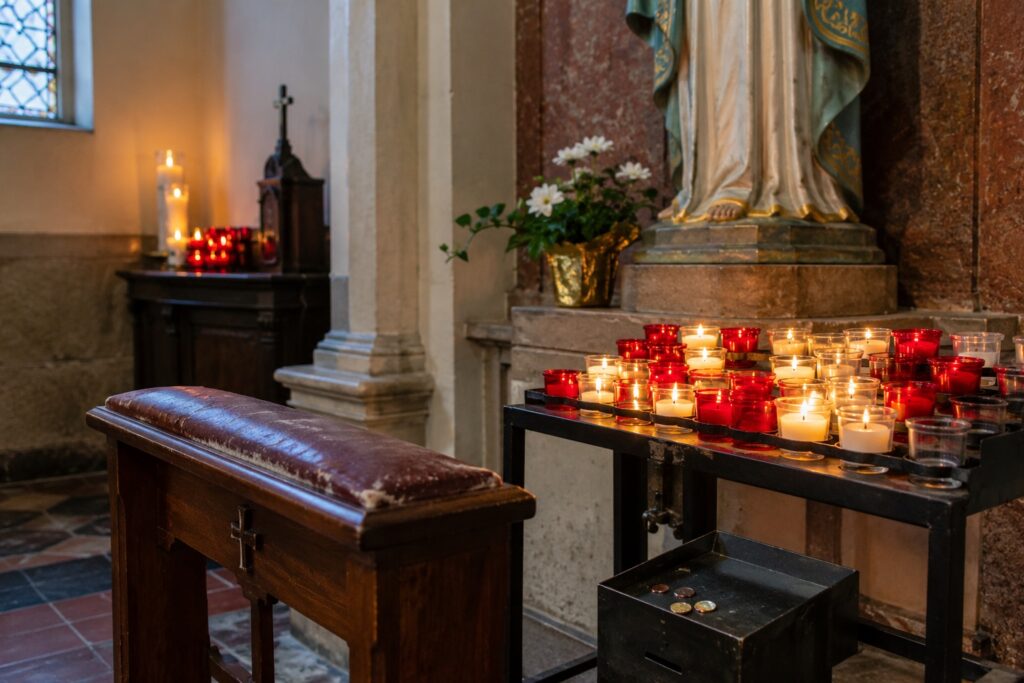
- “Saint statues are idols.” The Catechism says honor given to an image passes to the person it represents, and it’s veneration, not adoration (CCC 2132). A statue works much like a family photo.
- “Only canonized saints can be asked.” Canonized saints are those the Church has declared to be in heaven, so Catholics can ask their prayers with confidence. Many Catholics also privately ask a holy grandparent to pray for them. Public veneration, though, is reserved to those the Church has recorded among the saints or the blessed (canon 1187).
How to ask a saint to pray for you
It’s simpler than many people think. You talk to a saint the way you would talk to a friend who’s already close to God:
- Pick a saint. It might be your namesake, a patron of your work or situation, or someone whose story moves you. The Catechism notes that the saint whose name we receive at baptism provides “a model of charity” and that “we are assured of his intercession” (CCC 2156).
- Ask plainly. “St. Monica, please pray for my son.” “St. Joseph, pray for our family as we look for work.”
- Learn about them. Read a short life of the saint, or keep their feast day.
- Keep your prayer centered on God. Asking a saint’s prayers is a way of praying with the whole Church, not around God.
Many Catholics also pray the Hail Mary, which ends by asking Mary to pray for us “now and at the hour of our death.” The Catechism explains that by asking her to pray for us, “we acknowledge ourselves to be poor sinners” (CCC 2677).
If you’re looking for a saint for your daily work, start with our guide to patron saints of professions. Our articles on St. Homobonus, patron of business people, and on St. Christopher tell two of those stories in more depth, and our guide to Catholic symbols explains much of the imagery you’ll see in saint art.
Sources and further reading
- Catechism of the Catholic Church, nos. 946 to 959 (the communion of saints)
- Catechism of the Catholic Church, no. 2683 (the saints as guides for prayer)
- Catechism of the Catholic Church, nos. 2129 to 2132 (sacred images)
- Catholic Encyclopedia (1910): Intercession
- Catholic Encyclopedia (1909): Dulia
Next time you ask a friend to pray for you, try asking a saint too, and see how naturally the two fit together.