Walk into a Catholic church in mid-November and the priest is most likely wearing green. Come back on November 22 and he’ll be in white, then on November 29 in violet. The colors aren’t decoration or personal taste. They follow rules set out in the General Instruction of the Roman Missal (GIRM), and each one tells you something about what the Church is celebrating that day.
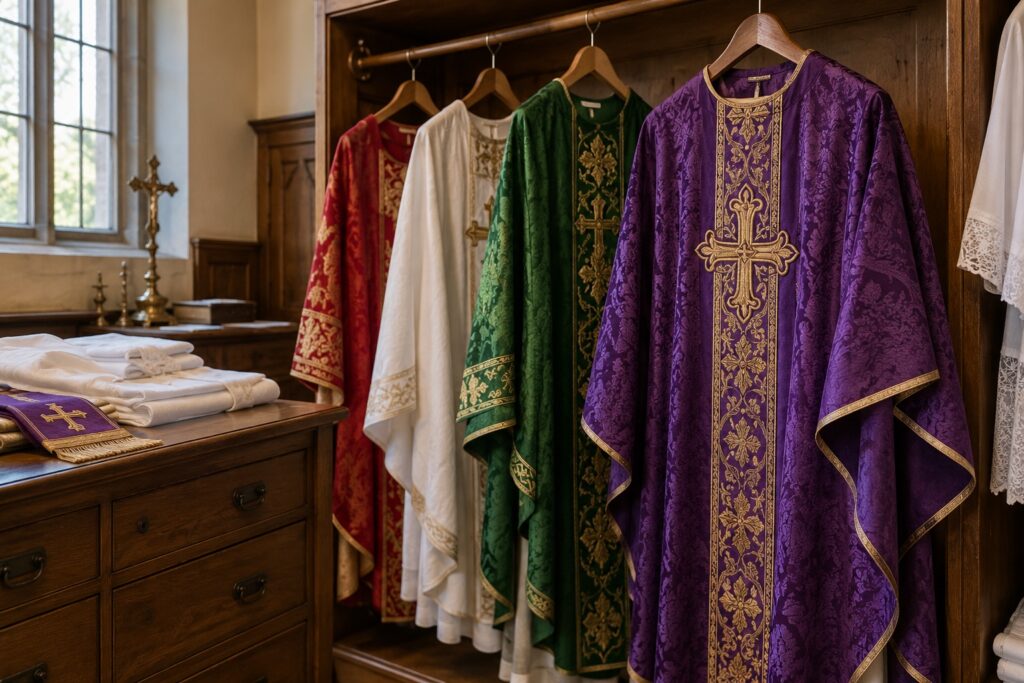
The Roman Rite uses four main liturgical colors: white, red, green and violet. Rose and black are permitted on certain days, and in the United States gold or silver may be worn on more solemn occasions. The GIRM explains the purpose plainly: the different colors give outward expression to the particular mystery of faith being celebrated and to the movement of Christian life through the liturgical year (GIRM 345).
The liturgical colors at a glance
| Color | When it is worn | Traditional meaning |
|---|---|---|
| White | Christmas and Easter seasons; feasts of the Lord (except his Passion), Mary, the angels and saints who were not martyrs; All Saints; optional in the U.S. for funerals | Light, joy, purity, glory |
| Red | Palm Sunday, Good Friday, Pentecost; feasts of the Passion, apostles, evangelists and martyrs | Fire of the Holy Spirit, the blood of martyrs, burning charity |
| Green | Ordinary Time | Hope and growing life |
| Violet (purple) | Advent and Lent; may be used for funerals and Masses for the Dead | Penance, preparation, waiting |
| Rose | Gaudete Sunday (Third Sunday of Advent) and Laetare Sunday (Fourth Sunday of Lent), where customary | Joy breaking into a season of penance |
| Black | Funerals and Masses for the Dead (permitted in the U.S.) | Mourning |
| Gold or silver | More solemn occasions (permitted in the U.S.) | Festivity and solemnity |
The “when it is worn” column comes from GIRM 346 and the USCCB’s summary of the colors. The “meaning” column reflects long-standing Catholic interpretation, described for example in the 1908 Catholic Encyclopedia. The rules are law. The symbolism is tradition, and you’ll see it phrased in slightly different ways by different writers.
Each color and what it means
White
White is the color of celebration. It is worn through the Christmas and Easter seasons, on celebrations of the Lord other than his Passion, on feasts of the Blessed Virgin Mary, the angels and saints who were not martyrs, and on solemnities such as All Saints (November 1) and the Nativity of St. John the Baptist (June 24). The Catholic Encyclopedia describes white as “the symbol of light,” standing for “innocence and purity, joy and glory.” On Sunday, November 22, 2026, the Solemnity of Our Lord Jesus Christ, King of the Universe, the priest will wear white.
Red
Red appears less often but always on striking days: Palm Sunday, Good Friday and Pentecost, along with feasts of the apostles, the evangelists and the martyrs. It carries two images at once. On Pentecost it recalls the tongues of fire of the Holy Spirit. On a martyr’s feast it recalls the blood the saint shed for Christ.
Green
Green is the color of Ordinary Time, the long stretches of the year outside the major seasons. The traditional reading of green is hope and life, which fits weeks spent following Christ’s public ministry Sunday by Sunday. If you go to Mass most of the summer, green is what you’ll see, as we noted in our look at summer in the Catholic liturgical calendar.
Violet
Violet, sometimes called purple, marks Advent and Lent. Both are seasons of preparation, though with different moods: Lent leans toward penance and conversion, Advent toward expectant waiting. Violet may also be worn at funerals and Masses for the Dead.
Rose
Rose is permitted on two Sundays a year, “where it is the practice”: Gaudete Sunday in Advent and Laetare Sunday in Lent. Both names come from the opening words of the old Latin Introit of the day: Gaudete (“Rejoice”) and Laetare Jerusalem (“Rejoice, O Jerusalem”). The lighter color is a pause for joy partway through a season of preparation. Not every parish owns rose vestments, so violet on those days is perfectly correct.
Black
Black may be worn at funerals and other Masses for the Dead in U.S. dioceses, alongside violet and white. It is the traditional color of mourning. Some parishes use it regularly, others rarely.
Gold and silver
The GIRM allows more precious, festive vestments on solemn days even if they aren’t the color of the day. For U.S. dioceses it adds that gold or silver vestments may be worn on more solemn occasions. That’s why a parish may use a gold chasuble on Easter or Christmas.
The colors on the calendar, November 2026 to Pentecost 2027
This is how the colors fall over the coming months. These dates are worked out from the 2026 and 2027 liturgical calendar (Easter 2027 is March 28), and the colors follow GIRM 346. Your parish may differ on days that allow a choice.
- Now until Advent begins: green for Ordinary Time, with white or red on many saints’ days
- Sunday, November 22, 2026, Christ the King: white
- Sunday, November 29, 2026, First Sunday of Advent: violet
- Sunday, December 13, 2026, Gaudete Sunday: rose or violet
- Friday, December 25, 2026, Christmas, through the Christmas season: white
- Wednesday, February 10, 2027, Ash Wednesday, and Lent: violet
- Sunday, March 7, 2027, Laetare Sunday: rose or violet
- Sunday, March 21, 2027, Palm Sunday: red
- Easter Sunday, March 28, 2027, and the Easter season: white
- Sunday, May 16, 2027, Pentecost: red
Today, November 11, is the memorial of St. Martin of Tours, a bishop who was not a martyr, so his Mass is celebrated in white. There’s a link to Advent here too. The Catholic Encyclopedia records that Advent began historically as a forty-day fast starting the day after St. Martin’s feast, which is why it was often called “St. Martin’s Lent.”
Where you will see the colors
The color of the day shows up most clearly on the chasuble, the outer vestment the priest wears over the alb and stole at Mass (GIRM 337). A deacon wears the dalmatic over the alb and stole (GIRM 338). Many parishes also change the cloth hanging from the front of the altar, the tabernacle veil where one is used, and the banners or fabric in the sanctuary.
At home, the colors turn up in the Advent wreath with its violet and rose candles, in purple cloth on a family prayer table during Lent, and in white flowers at Easter. Like the other signs explained in our guide to 22 Catholic symbols and their meaning, the colors are a way of teaching the faith through what people see.
A short history of the colors
The scheme wasn’t always this tidy. According to the Catholic Encyclopedia, Pope Benedict XIV wrote that white was the only liturgical color in use up to the fourth century. Pope Innocent III, who died in 1216, named four principal colors (white, red, green and black) and mentioned violet as used occasionally. Violet came into regular use from the 13th century, and since Pope St. Pius V in the 16th century the Roman Rite has followed a standard set of colors.
Local variations survived for a long time. The same encyclopedia notes that blue was used by special permission in some dioceses of Spain for the Mass of the Immaculate Conception. Blue is not among the colors listed in GIRM 346, so violet remains the color of Advent in the United States. Eastern Catholic Churches follow their own traditions of vestment color.
Frequently asked questions
Why does the priest sometimes wear a different color on a weekday?
The color follows the main celebration of the day. On a weekday in Ordinary Time the priest wears green, but if he celebrates a saint’s memorial, he may wear white or red instead. The USCCB notes that optional memorials, which may have a different color, can be chosen instead of the weekday.
What color is worn at a Catholic funeral?
In the United States the GIRM permits violet, white or black at funerals and Masses for the Dead. Our guide to planning a Catholic funeral covers the other choices a family makes.
Are pink and rose the same thing?
The official term is rose. Many people call it pink, and that’s fine in conversation. It’s used only on Gaudete and Laetare Sundays.
Can a parish use gold vestments instead of white?
Yes, on more solemn occasions in U.S. dioceses. The GIRM also allows especially fine festive vestments on solemn days even if they don’t match the day’s color.
To find Catholic-owned businesses near you, including religious goods shops, start with our directory search.