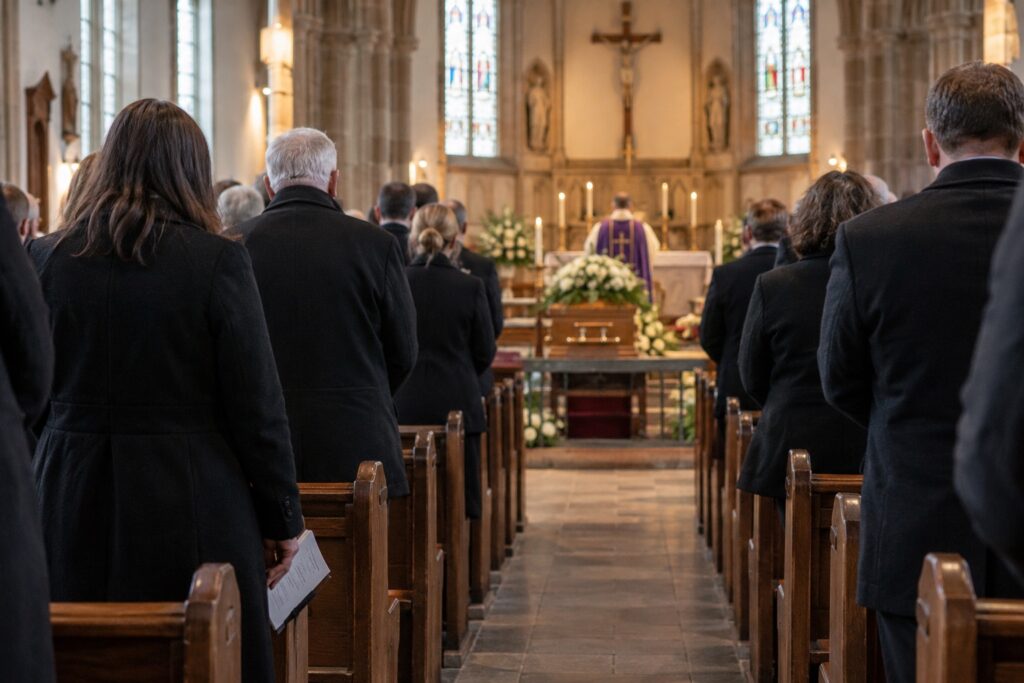
If you’re not Catholic and you’re going to a Catholic funeral, you’re welcome there, and nobody expects you to know the routine. Most Catholic funerals are a funeral Mass, which follows the same basic shape as a Sunday Mass: readings, a homily, prayers for the person who died, and Communion. You can follow along by standing when others stand and sitting when they sit. When Communion comes, the Church asks non-Catholics not to receive, but you can stay in your seat and pray, or, in many parishes, go forward with your arms crossed over your chest for a blessing.
Knowing the order of the service ahead of time, and a few small courtesies for the family, will keep anything from catching you off guard.
Before you go: what to wear and when to arrive
Dress as you would for any formal funeral: modest, darker colors, nothing flashy. A suit or dress slacks and a collared shirt, or a modest dress or skirt, will fit in anywhere. Arrive 10 to 15 minutes early so you can find a seat without hurrying.
You don’t need to do anything special at the door. Many Catholics dip their fingers in holy water and make the sign of the cross as they enter, and some genuflect (briefly kneel on one knee) before sliding into a pew. Neither is expected of you. Simply walk in quietly and take a seat. Family usually sits in the front pews, so leave those for them unless an usher directs you.
Some families hold a wake or visitation the evening before, often at a funeral home, with a short prayer service called the vigil. It’s a more relaxed setting and a good time to greet the family personally.
What happens during the funeral Mass
The beginning
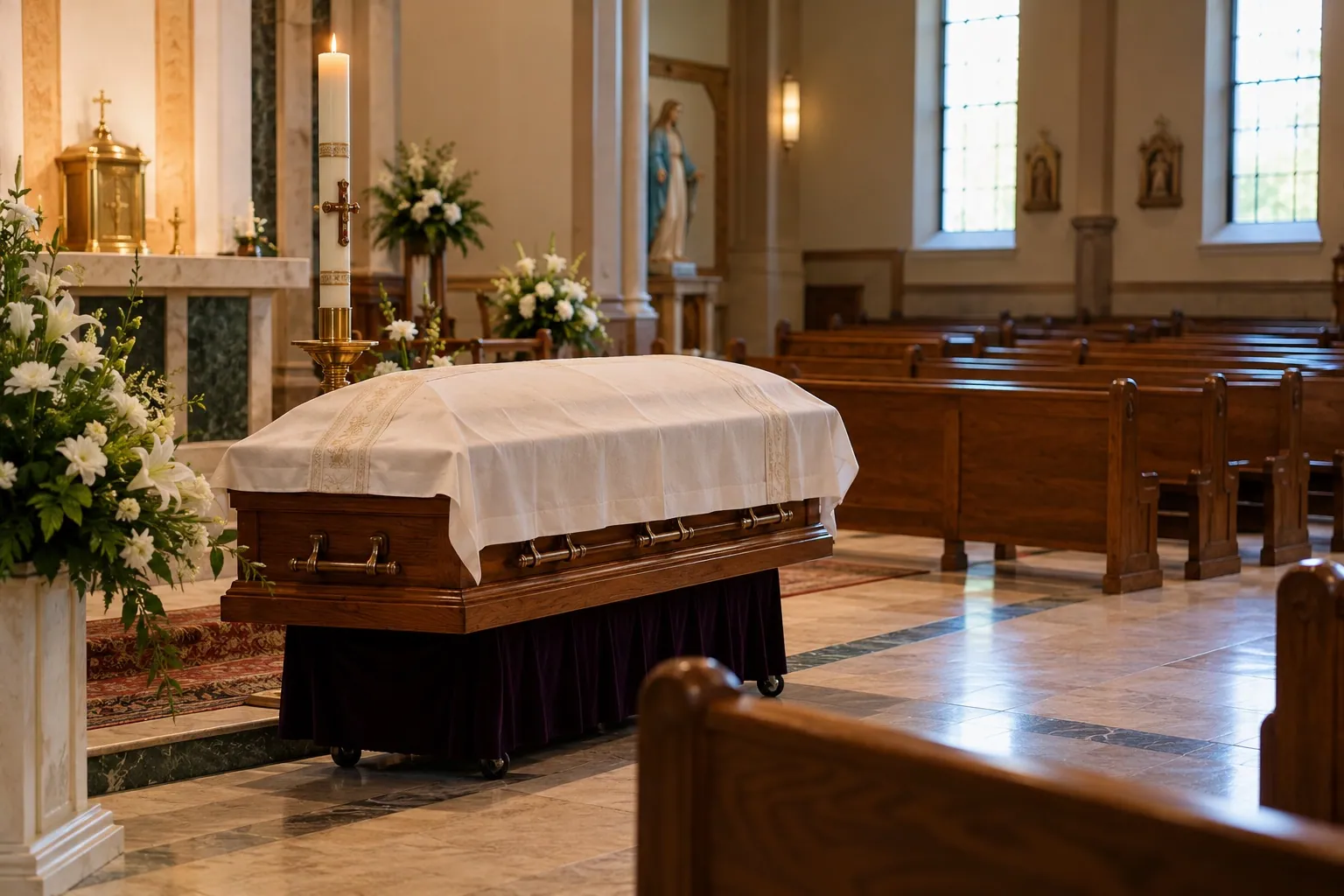
The funeral begins by receiving the casket into the church. It’s sprinkled with holy water and covered with a white cloth called a pall, both reminders of the person’s baptism, and it’s placed near the large Easter candle at the front. Then the Mass begins with a hymn and opening prayers.
The readings and homily
Family members or friends often read from the Bible, followed by a psalm and a Gospel reading. Everyone stands for the Gospel. The priest or deacon then gives a homily. Don’t be surprised if it isn’t a biography of the person. The Church asks that the homily focus on God’s mercy and the hope of the resurrection, seen in the life of the person who died, rather than being a eulogy.
The Eucharist and Communion
The middle of the Mass is the Liturgy of the Eucharist, the prayers over the bread and wine. Catholics kneel for much of this part if the church has kneelers. After the Lord’s Prayer, which you’re welcome to pray, there’s often a sign of peace, a handshake or nod with the people around you with the words “Peace be with you.” Then Communion is distributed.
The final commendation and farewell
After Communion, the priest leads the final commendation, the Church’s farewell to the person who died. If the family has arranged for someone to give brief words of remembrance, they usually come just before this. The service ends with the casket carried out in procession, often followed by a drive to the cemetery for a short committal prayer.
Stand, sit or kneel: how to follow along
The table maps the postures. Don’t worry about getting them perfect.
| Part of the Mass | What Catholics usually do | What you can do |
|---|---|---|
| Entrance and opening prayers | Stand | Stand |
| First reading, psalm, second reading | Sit | Sit |
| Gospel | Stand | Stand |
| Homily | Sit | Sit |
| Eucharistic Prayer | Kneel (or stand where there are no kneelers) | Kneel, or sit quietly if kneeling is uncomfortable |
| Lord’s Prayer and sign of peace | Stand | Stand |
| Communion | Come forward or remain in the pew | Remain seated, or come forward for a blessing where that’s the custom |
| Final commendation and procession | Stand | Stand |
A printed worship aid often lists the readings and hymns. Feel free to sing and say the parts you’re comfortable with, and simply listen during the rest.
Should a non-Catholic receive Communion at a Catholic funeral?
This is the question guests worry about most. The U.S. bishops’ guidelines for receiving Communion welcome other Christians “as our brothers and sisters,” but explain that because Catholics believe the Eucharist is “a sign of the reality of the oneness of faith, life, and worship,” members of churches not fully united with the Catholic Church “are ordinarily not admitted to Holy Communion.” Exceptions require the bishop’s permission under canon law.
Members of the Orthodox churches, the Assyrian Church of the East and the Polish National Catholic Church are a special case. The guidelines ask them to respect the discipline of their own churches, and note that Catholic law doesn’t object to their receiving Communion.
To guests who aren’t Christian, the bishops say: “We also welcome to this celebration those who do not share our faith in Jesus Christ. While we cannot admit them to Holy Communion, we ask them to offer their prayers for the peace and the unity of the human family.”
This isn’t meant as a judgment on anyone. For Catholics, receiving Communion expresses full unity in faith, and the Church asks everyone to respect what the act means. You have two good options. Stay in your pew and pray quietly while others go forward, stepping aside to let people out if you’re on an aisle. Or, where the parish allows it, join the line with your arms crossed over your chest, and the priest will give you a blessing. The Archdiocese of New York describes both options. Practice differs from diocese to diocese, so if you’re unsure, staying seated is always fine.
Kind gestures for the family
A few courtesies matter more than knowing every posture:
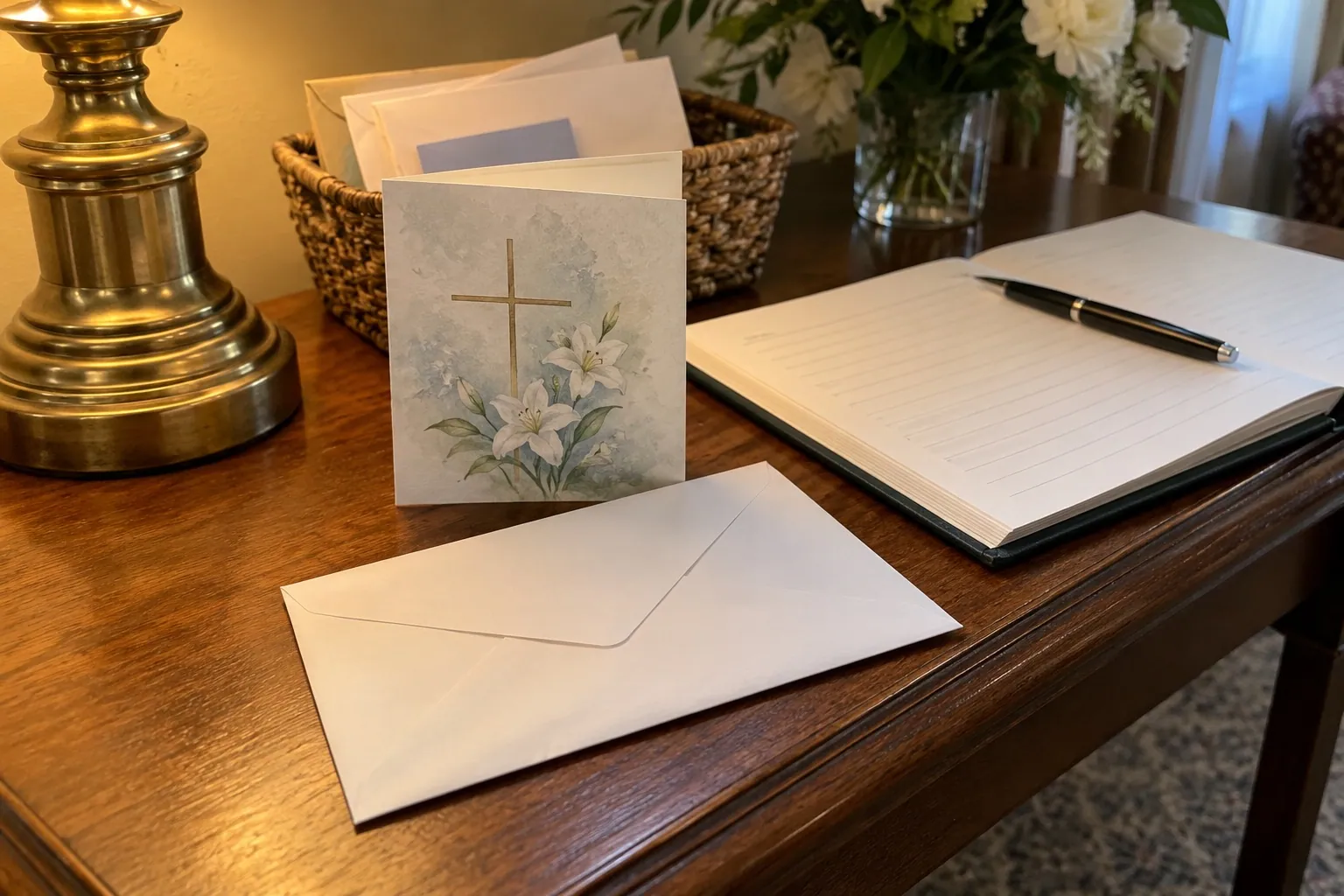
- Sign the guest book at the wake or funeral so the family knows you came.
- A sympathy card with a short memory of the person often means a great deal later.
- Consider a Mass card. Catholics often have a Mass offered for someone who has died, and anyone can arrange one by calling a Catholic parish. Church law allows a Mass to be offered for anyone, living or dead, and our guide to getting a Mass card walks through the steps.
- Keep phones silenced and put away, and avoid conversation in the church before the service begins.
- If there’s a luncheon or reception afterward, go if you can. It’s often where the family has time to talk.
If you’re curious about the symbols you’ll see, from the crucifix to the candles, our guide to Catholic symbols and their meaning explains them in plain language.
Frequently asked questions
Do I have to kneel at a Catholic funeral?
No. If kneeling goes against your conscience or is physically difficult, sitting quietly while others kneel is respectful and perfectly acceptable.
Should I make the sign of the cross?
Only if you’re comfortable doing so. It’s a Catholic prayer gesture, not a requirement for guests.
Can I say the prayers and sing the hymns?
Yes. You’re welcome to join in whatever you’re comfortable saying, and simply listen to the rest.
Can I speak at the funeral?
That’s up to the family and the parish. Words of remembrance at a funeral Mass are kept brief, some dioceses allow only one speaker, and each diocese sets its own guidelines. The wake or the vigil service is often a better setting for longer tributes, as our guide to planning a Catholic funeral explains.
Sources and further reading
- USCCB Guidelines for the Reception of Communion (via the National Eucharistic Revival)
- Archdiocese of New York: Guidelines for the Reception of Holy Communion
- Archdiocese of Detroit: What are the funeral rites?
- Catechism of the Catholic Church, nos. 1684 to 1690 (Christian funerals)
To learn more about what Catholics believe, our introduction to being a Catholic is a friendly place to start.