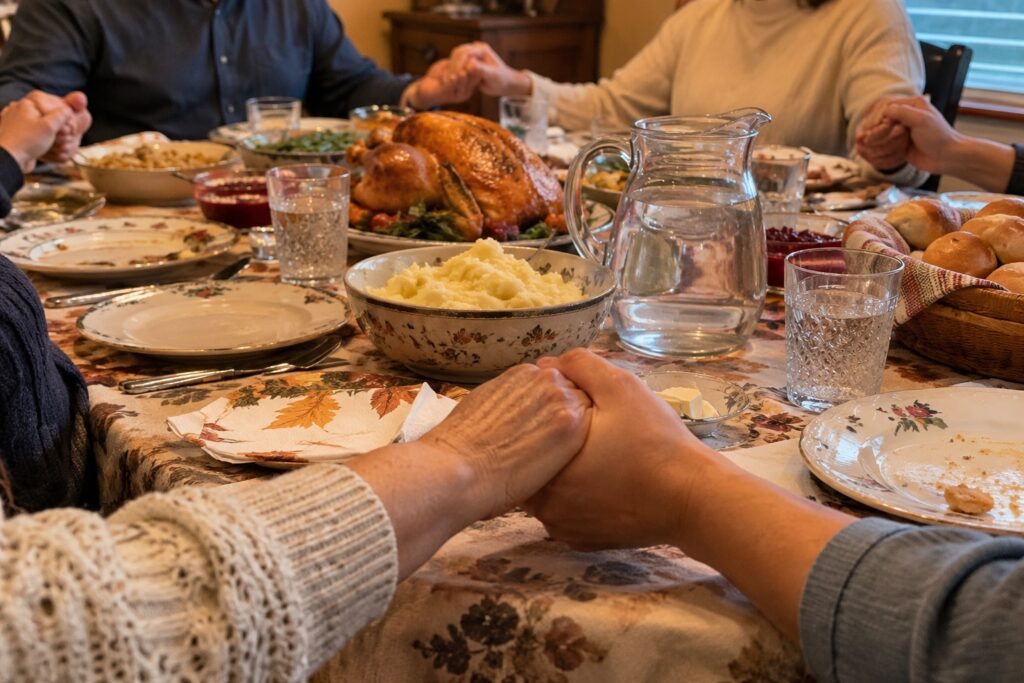
Most Catholics learned the same short prayer as children and can still say it without thinking: “Bless us, O Lord, and these Thy gifts…” On Thursday, November 26, 2026, it will be said at a lot of Thanksgiving tables, sometimes by people who haven’t prayed out loud in a while.
Fewer people know the grace that goes with it after the meal, or how old the words are. Both are worth bringing back this year, along with a few approved prayers that work at a table where not everyone shares your faith.
The Catholic grace before meals
This is the traditional text as published by the Archdiocese of Saint Paul and Minneapolis:
Bless us, O Lord, and these Thy gifts,
which we are about to receive from Thy bounty,
through Christ our Lord.
Amen
Many families and parishes use a contemporary form with “your” in place of “Thy.” The Archdiocese of Grouard-McLennan’s family meal prayers give it this way:
Bless us, O Lord, and these your gifts which we are about to receive from your bounty. Through Christ our Lord. Amen
Both are the same prayer. Use whichever your family knows. Catholics usually begin and end grace with the Sign of the Cross.
The grace after meals most people forget
The Church’s tradition has a prayer for after the meal too, and it includes a short prayer for the dead. This is the text in the Baltimore Catechism No. 3, the catechism prepared at the direction of the Third Plenary Council of Baltimore (full text at Project Gutenberg):
We give Thee thanks for all Thy benefits, O Almighty God, who livest and reignest for ever; and may the souls of the faithful departed, through the mercy of God, rest in peace. Amen.
A contemporary form, from the same Grouard-McLennan collection:
We give you thanks, Almighty God, for these and all the benefits we receive from your bounty. Through Christ our Lord. Amen.
November, the month that opens with All Saints and All Souls, is a fitting time to bring back the older form with its line for “the souls of the faithful departed.” A holiday table can make an absence keenly felt, and this is a simple way to remember the people who used to sit there.
Where the prayers come from
“Grace” itself means thanks. The Catholic Encyclopedia notes that the word, as applied to prayer over food, “means nothing but thanksgiving,” like the Italian grazie. The habit goes back to Jesus, who gave thanks before feeding the crowds, and to the apostles. St. Paul, on a ship caught in a storm, “took bread, gave thanks to God in front of them all, broke it, and began to eat” (Acts 27:35).
The early Christians kept it up. Tertullian, writing early in the third century, said Christians did not sit down to a banquet until they had prayed, and that prayer also ended the meal. The words “Bless us, O Lord, and these Thy gifts” are much older than most people guess: the Catholic Encyclopedia traces them to the Gelasian Sacramentary, one of the Church’s early liturgical books. The short grace children learn is essentially a translation of two parts of a longer Latin grace once printed in the Roman Breviary.
There is a deeper link, too. The Catechism explains that the Mass is called the Eucharist “because it is an action of thanksgiving to God,” and that the Greek words behind it “recall the Jewish blessings that proclaim, especially during a meal, God’s works” (CCC 1328). Grace at the kitchen table is a small echo of the great thanksgiving at the altar.
Prayers that suit a Thanksgiving table
The Compendium of the Catechism lists prayer before and after meals among the daily rhythms of prayer the Church proposes (no. 567). Thanksgiving is simply the day when the whole country does it at once. The holiday itself began with official calls to prayer: the Catholic Encyclopedia records that President Washington recommended Thursday, November 26, 1789, as “a day of public thanksgiving and prayer,” and President Lincoln’s proclamation followed in 1863.
Beyond the traditional grace, the Grouard-McLennan collection offers prayers that fit the day well. This one keeps the poor in view:
For food in a world where many walk in hunger, for friends in a world where many walk alone, for faith in a world where many walk in fear, we give you thanks, O God. Amen.
And this one remembers the people who made the meal possible:
Loving God, all that we have comes from your goodness and the work of those who love us.
Bless us and the food we eat.
Watch over those who care for us.
Open our eyes to the needs of the poor.
We ask this in the name of Jesus. Amen.
A Scripture verse also works as a short grace. St. Paul’s words to Timothy, which St. John Paul II quotes in Dies Domini, fit the day: “everything created by God is good, and nothing is to be rejected when received with thanksgiving” (1 Tim 4:4).
Teaching children to say grace
Children learn grace by hearing it, not by being drilled. Some things that help:
- Say the same words every day, so they become automatic and then, later, meaningful.
- Let children take turns leading, even the youngest, once they know the words.
- After the set prayer, invite each person to name one thing they’re thankful for.
- Keep the Sign of the Cross slow and deliberate. Children copy what they see.
- Add the after-meal grace once the before-meal one is second nature.
For very young children, the Grouard-McLennan booklet includes simple rhymes, such as this one: Thank you God for milk and bread and other things so good. Thank you God for those who help to grow and cook our food. Amen.
Saying grace with guests of other faiths
Thanksgiving tables often bring together Catholics, other Christians, people of other religions and people with no faith at all. Grace can still be a moment that includes everyone.
The host sets the tone. A simple invitation works: “In our family we say a short prayer before we eat. You’re welcome to join us or just take a quiet moment.” Then pray the familiar grace or a prayer like “For food in a world where many walk in hunger,” which speaks of gratitude in words almost anyone can share. Other Christians at the table will often be glad to pray along, and no one should be pressured.
The same approach fits a workplace holiday lunch. A Catholic owner or manager can offer a brief blessing and make it plainly optional. Our article on prayer practices for Catholic business leaders has more ideas for praying in a work setting without making anyone uncomfortable.
Frequently asked questions
Do Catholics make the Sign of the Cross when saying grace?
Usually, yes, before and after. Tertullian already describes Christians making the sign of the cross at table in the early third century, according to the Catholic Encyclopedia’s article on grace at meals.
Is it “Thy gifts” or “your gifts”?
Both are used and both are fine. The “Thy” form is older; the “your” form is common in newer prayer books and parish materials.
Should we pray in a restaurant?
There’s no rule either way. Many Catholics quietly make the Sign of the Cross and pray silently. If you’re eating out over the holiday weekend, you can find Catholic-owned restaurants near you in our business directory.