St. Peter was the first pope. Simon, a fisherman from Galilee whom Jesus renamed Peter, or “rock,” led the apostles after the Ascension, preached the first sermon at Pentecost and died a martyr in Rome under the Emperor Nero, most likely between the years 64 and 67. The Catholic Church counts every Bishop of Rome since then as his successor.
That line now runs to 267 popes. Pope Francis died on April 21, 2025, and on May 8, 2025, the cardinals elected Cardinal Robert Francis Prevost, who took the name Leo XIV. He is the 267th pope and the first from the United States.
St. Peter at a Glance
| Birth name | Simon, son of John (John 1:42) |
| New name | Cephas in Aramaic, Peter in Greek; both mean “rock” |
| Hometown | Bethsaida in Galilee (John 1:44); he later lived in Capernaum |
| Work | Fisherman on the Sea of Galilee, with his brother Andrew |
| Role | Leader of the Twelve Apostles and first Bishop of Rome |
| Death | Martyred in Rome under Nero, probably between 64 and 67 |
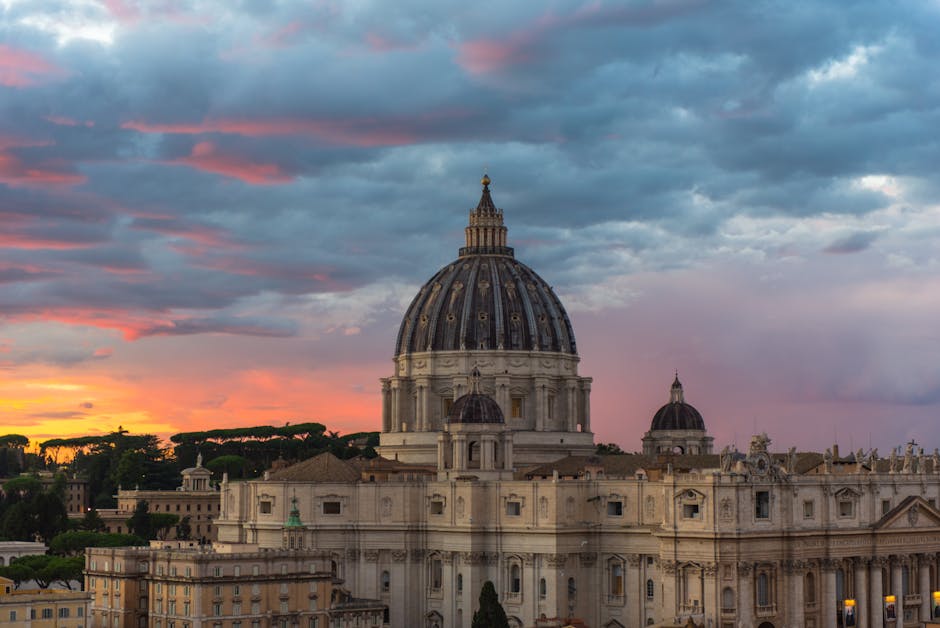
| Burial | Vatican Hill, beneath what is now St. Peter’s Basilica |
| Feast days | June 29 (Sts. Peter and Paul) and February 22 (Chair of St. Peter) |
| Next popes | Linus, Anacletus (Cletus) and Clement |
Introduction to St. Peter
Peter was originally named Simon. The Gospel of John says he came from Bethsaida, the town of Andrew and Philip, and the Gospels place his household in Capernaum on the Sea of Galilee, where Jesus healed his mother-in-law. He and his brother Andrew fished for a living.
He is named more often in the New Testament than any other apostle, and his name always comes first in the lists of the Twelve (Matthew 10:2). He is also the apostle whose failures the Gospels record most honestly, which is part of why Catholics find him so easy to love.
The Calling of Peter
Matthew’s Gospel describes Jesus walking by the Sea of Galilee and seeing Simon and Andrew casting a net into the water:
“Follow me, and I will make you fishers of men.”
Matthew 4:19
They left their nets at once and followed him. John’s Gospel adds a detail: when Andrew first brought his brother to Jesus, Jesus looked at him and said, “So you are Simon the son of John? You shall be called Cephas” (John 1:42). Cephas is the Aramaic word for rock; Peter is its Greek form.
Peter’s Confession of Faith
The turning point came near Caesarea Philippi, when Jesus asked his disciples who people said he was, and then pressed the question:
“But who do you say that I am?”
Matthew 16:15
Simon Peter answered for the group:
“You are the Christ, the Son of the living God.”
Matthew 16:16
Jesus told him that this answer had not come from “flesh and blood” but from the Father, and then he made Peter a promise no other apostle received.
The Foundation of the Papacy
“And I tell you, you are Peter, and on this rock I will build my church, and the powers of death shall not prevail against it. I will give you the keys of the kingdom of heaven, and whatever you bind on earth shall be bound in heaven, and whatever you loose on earth shall be loosed in heaven.”
Matthew 16:18 to 19
The Catechism reads this passage as the root of Peter’s office: “The Lord made Simon alone, whom he named Peter, the ‘rock’ of his Church. He gave him the keys of his Church and instituted him shepherd of the whole flock” (CCC 881).
The Significance of the “Rock”
A rock is what a builder sets a house on. By renaming Simon “Rock,” Jesus made him the visible foundation of the community he was gathering. Catholics do not read this as Peter replacing Christ, who remains the cornerstone, but as Christ choosing one man to hold his followers together.
The Keys of the Kingdom
In the ancient world the person who held the keys of a household ran it on the owner’s behalf. The Catechism explains that the “power of the keys” designates “authority to govern the house of God, which is the Church,” and that binding and loosing “connotes the authority to absolve sins, to pronounce doctrinal judgements, and to make disciplinary decisions in the Church” (CCC 553). The crossed keys on the papal coat of arms come from this verse; you can read more about them in our guide to Catholic symbols and their meanings.
Peter’s Role Among the Apostles
Throughout the Gospels Peter speaks for the Twelve, asks the questions the others are thinking and is present at the key moments:
- The Transfiguration: Peter, James and John see Jesus transfigured on “a high mountain” (Matthew 17:1 to 9), which tradition identifies as Mount Tabor.
- Walking on water: Peter steps out of the boat toward Jesus, then sinks when he looks at the wind (Matthew 14:28 to 31).
- The Last Supper: Jesus tells Peter he has prayed that his faith “may not fail,” and that once he has turned again he must “strengthen your brethren” (Luke 22:32).
Peter’s Denial and Redemption
The same night, Peter swore he would go to prison and death with Jesus. Jesus answered:
“I tell you, Peter, the cock will not crow this day, until you three times deny that you know me.”
Luke 22:34
It happened as Jesus said. In the high priest’s courtyard Peter denied knowing him three times, then caught the Lord’s eye and “went out and wept bitterly” (Luke 22:62). His tears are one of the Church’s oldest pictures of contrition, the sorrow that the Act of Contrition puts into words.
After the Resurrection, on the shore of the same lake where he was first called, Jesus asked Peter three times whether he loved him:
“Simon, son of John, do you love me?”
John 21:17
Each time Peter said yes, and each time Jesus gave him a charge: “Feed my lambs,” “Tend my sheep,” “Feed my sheep” (John 21:15 to 17). Three denials, three declarations of love, and a shepherd’s commission at the end of it.
The Early Church and Peter’s Leadership
The Acts of the Apostles shows Peter leading from the first days after the Ascension:
- Choosing Matthias: Peter stands up among the believers and proposes that someone be chosen to replace Judas (Acts 1:15 to 26).
- Pentecost preaching: Peter preaches the first public sermon, and “about three thousand souls” are baptized that day (Acts 2:14 to 41).
- Council of Jerusalem: When the apostles and elders meet over whether Gentile converts must keep the Mosaic Law, Peter rises to remind them that God gave the Holy Spirit to Gentiles too (Acts 15:7 to 11).
Peter’s Missionary Work
Peter traveled to the young Christian communities around Judea and beyond:
- Lydda and Joppa: He heals Aeneas, a man paralyzed and bedridden for eight years, and raises the disciple Tabitha from death (Acts 9:32 to 43).
- Caesarea: He baptizes the Roman centurion Cornelius and his household, the first Gentiles Acts describes receiving the Spirit and baptism through Peter (Acts 10).
- Antioch: Paul mentions Peter’s time in Antioch, including a sharp disagreement between them over table fellowship with Gentiles (Galatians 2:11 to 14).
Peter in Rome
Scripture does not narrate Peter’s arrival in Rome, but early Christian writers agree that he taught there and died there. By the late second century St. Irenaeus could describe the Roman Church as “founded and organized at Rome by the two most glorious apostles, Peter and Paul” (Against Heresies III.3.2).
- Martyrdom: Peter died in Nero’s persecution. The year is not certain; the Catholic Encyclopedia notes that 67 is the date generally held, while some scholars argue for 64.
- Crucified head downward: The theologian Origen, quoted by the historian Eusebius, records that “Peter was crucified at Rome with his head downwards, as he himself had desired to suffer.”
- His tomb: He was buried on the Vatican Hill. Constantine built a basilica over the grave in the fourth century, and the present St. Peter’s Basilica replaced it in the sixteenth. In 1968 Pope Paul VI announced that bones found in the excavations beneath the altar had been identified in a way he considered convincing as Peter’s.
The Legacy of Peter’s Papacy
Catholics believe Peter’s role did not end with his death. The Bishop of Rome inherits it. In the words of the Catechism, the Pope, “Bishop of Rome and Peter’s successor, ‘is the perpetual and visible source and foundation of the unity both of the bishops and of the whole company of the faithful'” (CCC 882).
Apostolic Succession
The authority Christ gave the apostles passes to their successors, the bishops, and the authority given to Peter passes to the pope. The Catechism adds that the office of binding and loosing given to Peter “was also assigned to the college of apostles united to its head” (CCC 881), which is why Catholics speak of the bishops governing the Church together with and under the pope.
The Petrine Ministry
When Pope Benedict XVI took possession of his cathedral, St. John Lateran, on May 7, 2005, he described the office this way:
“The Pope is not an absolute monarch whose thoughts and desires are law. On the contrary: the Pope’s ministry is a guarantee of obedience to Christ and to his Word.”
Pope Benedict XVI, homily of May 7, 2005
The Papacy’s Foundation in Scripture and Tradition
Catholics point to both Scripture and the testimony of the early Church when they explain why Peter is counted as the first pope.
Scriptural Foundations
- The rock and the keys: Matthew 16:18 to 19, quoted above.
- Strengthen your brethren: Jesus prays for Peter’s faith and charges him to strengthen the others (Luke 22:32).
- Feed my sheep: The risen Christ entrusts his flock to Peter (John 21:15 to 17).
Sacred Tradition
- St. Irenaeus of Lyons (late second century) traces the bishops of Rome back to the apostles, naming Linus as the first to receive the office after them.
- Tertullian (about 220) records a bishop of Rome claiming that Peter’s power to forgive sins had come down to him in a special way, a claim that only makes sense if Rome counted Peter as its first bishop.
- Early Roman lists of bishops, including one attributed to Hippolytus in the early third century, place Peter at the head of the line.
Events During Peter’s Papacy
Nobody knows exactly how long Peter led the Church. Some ancient bishop lists give him a 25 year episcopate in Rome, but the Catholic Encyclopedia treats that figure as a later addition of uncertain origin. What can be said is that his leadership ran from the first Pentecost to his death in Rome in the 60s.
Establishment of Church Structure
Under the apostles the first communities took shape: the Twelve were filled out by Matthias, the Seven were appointed to serve the Greek speaking widows (Acts 6), and elders were set over local churches.
Resolving Doctrinal Disputes
The biggest early question was whether Gentile converts had to keep the Mosaic Law. Peter’s witness about Cornelius carried weight at the Council of Jerusalem, which decided they did not (Acts 15).
Persecution of Christians
Peter himself was imprisoned in Jerusalem by King Herod and miraculously freed (Acts 12), and his life ended in Nero’s persecution in Rome. His first letter speaks directly to Christians suffering for their faith.
Peter’s Writings
Two letters in the New Testament carry Peter’s name:
- First Peter: Encourages Christians facing hostility to hold on to hope and live as “a chosen race, a royal priesthood” (1 Peter 2:9).
- Second Peter: Warns against false teachers and urges readers to grow in the knowledge of Christ.
Early tradition also links Peter with the Gospel of Mark. Papias and Clement of Alexandria, citing the generation that knew the apostles, say Mark wrote his Gospel in Rome at the request of Christians there who wanted Peter’s preaching in writing.
The Symbolism of the Papal Office
Several familiar papal symbols point straight back to Peter.
The Papal Keys
Two crossed keys, one gold and one silver, appear on the coat of arms of the Holy See. They stand for the keys of the kingdom promised in Matthew 16:19: the gold key for power that reaches to heaven, the silver for authority over the faithful on earth.
The Fisherman’s Ring
Each new pope receives a Ring of the Fisherman, a reminder that Peter was a fisherman whom Jesus made a “fisher of men.” Pope Leo XIV received his at his inauguration Mass on May 18, 2025; it shows St. Peter holding the keys, with a fisherman’s net. When a pope dies, his ring is defaced so it can never be used as a seal again.
The Chair of Peter
The Church keeps a feast of the Chair of St. Peter on February 22, celebrated in white vestments (General Instruction of the Roman Missal 346). The “chair” is the teaching office itself: a bishop’s chair, or cathedra, is the sign of his authority to teach.
The Continuity of Peter’s Mission
Catholics see the long line of Peter’s successors as one way Christ keeps his last promise in Matthew’s Gospel:
“And lo, I am with you always, to the close of the age.”
Matthew 28:20
The Popes After Peter
The earliest lists agree on the names of the next three bishops of Rome, though they do not all agree on the order. Most, following St. Irenaeus, give it as Linus, then Anacletus (also called Cletus), then Clement. Clement is the author of a letter to the church in Corinth, written in the first century, that is one of the oldest Christian writings outside the New Testament. Linus, Cletus and Clement are still named together in the Roman Canon, the first Eucharistic Prayer of the Mass.
The word “pope” itself came later. It comes from the Greek word for father. In the West it was used of bishops in general before it became, from about the fourth century, the distinctive title of the Bishop of Rome. The office is older than the title.
The Significance for Catholics Today
Knowing that the papacy begins with a fisherman who denied Jesus and was forgiven helps keep the office in perspective. The pope is not chosen for being the holiest man in the Church but to do what Peter was told to do: strengthen his brothers and feed the sheep.
Unity and Universality
The pope is the visible center of unity for more than a billion Catholics in every country. Every Eucharistic Prayer at Mass names him, so Catholics in every country pray for the same man by name.
Teaching Authority
Together with the bishops in communion with him, the pope exercises the Magisterium, the Church’s teaching office, which guards and hands on the faith received from the apostles.
Frequently asked questions
Who was the first pope of the Catholic Church?
St. Peter the Apostle, whom Jesus called the rock on which he would build his Church (Matthew 16:18). He led the Church from Pentecost until his martyrdom in Rome in the mid 60s.
Who was the second pope?
St. Linus, according to St. Irenaeus and most early lists. He was followed by Anacletus (Cletus) and then Clement.
When did Peter become pope?
Catholics date Peter’s leadership to the beginning of the Church’s public life after the Ascension and Pentecost, in the early 30s. His time as Bishop of Rome came later, and its length is not known with certainty.
Who is the pope now, and how many popes have there been?
Pope Leo XIV, elected on May 8, 2025, after the death of Pope Francis on April 21, 2025. Counting St. Peter, he is the 267th pope.
Where is St. Peter buried?
Under the high altar of St. Peter’s Basilica in Vatican City, on the Vatican Hill where he was buried after his martyrdom.
Sources and further reading
- Catechism of the Catholic Church 880 to 882, the pope and the bishops (vatican.va)
- Catechism of the Catholic Church 551 to 553, the keys of the kingdom (vatican.va)
- Pope Benedict XVI, homily at St. John Lateran, May 7, 2005 (vatican.va)
- Catholic Encyclopedia (1911), St. Peter, Prince of the Apostles (New Advent)
- Catholic Encyclopedia (1911), The Pope (New Advent)
- Vatican News, Pope Francis dies on Easter Monday aged 88